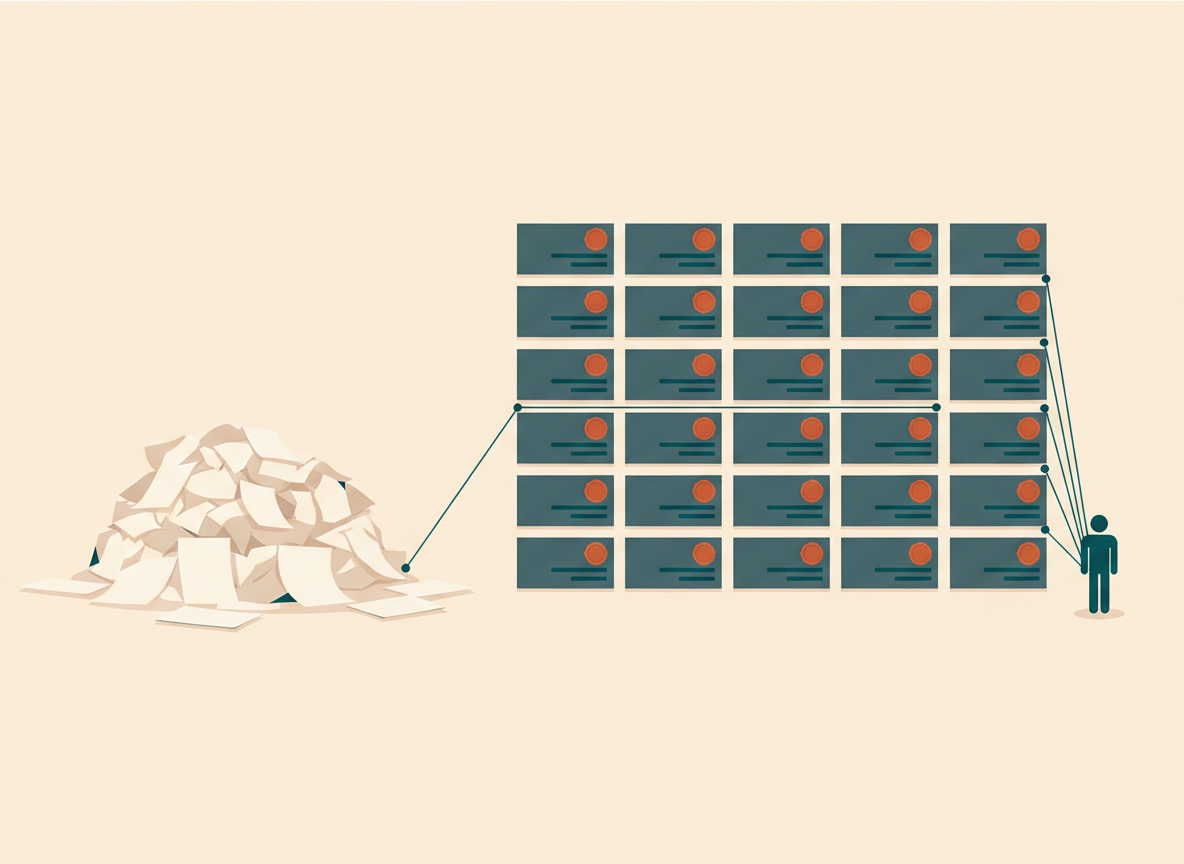
You operationalize a principle by turning it into an artifact somebody else can check. A principle you cannot evidence is a press release. The working test is simple: if a regulator, a court, or the person affected asked tomorrow why an AI system did what it did, could you reconstruct the answer from records that existed at the time, rather than ones you wrote afterward?
The chain: principle, control objective, owner, artifact
A principle only becomes operational when it has been broken down three times.
- The principle becomes a control objective: something you can pass or fail, not something you can agree with.
- The objective becomes a requirement with a named owner: a person, not a department.
- The requirement produces an artifact that somebody independent can inspect.
The third step is where most programs stop short. Plenty of organizations have a fairness commitment and a responsible AI policy. Far fewer can produce the record showing that a specific system was tested, by whom, against what threshold, and who accepted the result.
The structural safeguard is separation. One function sets the requirement, a different function implements it, and a third assures it, and the assurer never validates its own work. Without that split, the organization is marking its own homework, and the evidence it produces is worth roughly what a self-assessment is worth in an audit.
Transparency has three audiences, and most organizations document one
Transparency is usually treated as a single obligation. It is three, and they need different records.
To the regulator. An inventory of AI systems and an intake record for each one: what it does, whether you are the provider or the deployer, what data it uses, which assessments it triggered, and who owns it. If you cannot list your AI systems, nothing downstream is credible.
To the user or the audience. A recorded disclosure decision per system. Since the EU AI Act’s Article 50 obligations began to apply in August 2026, that means deciding, and writing down, whether output must be labeled, and on what basis. Synthetic depictions of real people should be labeled without exception, whatever the exemptions permit.
To the affected individual. An explanation they can actually understand, and a route to contest the outcome. An explanation nobody can act on is a disclosure, not transparency.
A gap worth looking for in your own framework: the per-system transparency determination. The obligation usually exists in policy, the labeling usually happens in practice, but very often nothing records that the question was assessed system by system. When a regulator asks how you decided, “our policy says so” is not an answer about this system.
Fairness is a recorded choice, not a score
There is no single definition of fairness, which means the evidence cannot be a number on its own. It has to be a decision you can defend.
Before deployment, record five things: which fairness definition applies to this use case and why; which population you tested against; what threshold you accepted; who accepted it; and when it gets re-tested. Those five lines do more in a regulatory conversation than a dashboard of metrics nobody chose deliberately.
One rule keeps the rest honest: a control that is not actually operating cannot be credited against residual risk. Many AI risk registers look reassuring only because they count controls that exist as policy statements rather than as running practice. If the bias test is scheduled quarterly and has run once, the register should show the risk as it actually stands, not as the schedule intended.
Accountability is an allocation, written at intake
Accountability should follow decision rights, not the organization chart, and it should be recorded when the system is approved rather than negotiated after something goes wrong.
| Party | Accountable for | Evidence it leaves |
|---|---|---|
| Business owner | The purpose and the outcome: choosing to use AI here, defining what good looks like, accepting the residual risk | Signed risk acceptance with an expiry date |
| Technology | The system performing as specified: integration, access, monitoring, logging, drift detection | Monitoring configuration, change records, drift alerts |
| Vendor | What they represent and what they change: model behavior, data provenance, security, incident and model-change notification | Contract terms, provenance statements, change notices received |
| Human reviewer | Their own judgment, but only where they had authority, information and time | Review and override logs |
| Compliance | Assurance: setting requirements, validating them, escalating | Assessment reports, findings tracked to closure |
Two rules sit over the table. First, a silent model update is a new system that nobody approved, so the vendor’s duty to notify you of changes is a governance control, not a commercial nicety. You can outsource the function; you cannot outsource the accountability. Second, if a human reviewer could not realistically have said no; no authority, no information, or no time; then the person who designed that process is the accountable party, not the reviewer whose name is on the approval.
The evidence set
This is the minimum an organization should be able to produce, per AI system, without a fire drill.
| Artifact | What it proves | Created when |
|---|---|---|
| AI inventory and intake record | The system exists, is classified, and has an owner | At intake, before build |
| Impact assessment (DPIA, AI impact assessment or FRIA) | The effects on people were considered before deployment | Before go-live, re-run on material change |
| Training data and provenance register | You know what the system learned from and on what basis | At build, updated per model version |
| Transparency and labeling determination | Disclosure was assessed for this system, not just in policy | Before go-live |
| Test results with accepted thresholds | Performance and fairness were measured against a standard someone chose | Pre-deployment and on each re-test |
| Human review and override logs | Oversight actually happened and sometimes changed the outcome | Continuously, in production |
| Incident and corrective action trail | Failures were detected, fixed, and verified by someone other than the fixer | On each incident, closed with verification |
Anchor the set in a management system; ISO/IEC 42001 is the obvious candidate, so that it is audited on a cycle rather than reassembled every time somebody asks. Evidence produced in response to an inquiry always looks like evidence produced in response to an inquiry.
Where it fails, and where to start
Four failure patterns show up repeatedly.
- The self-declared tier. Ask a project team “is this high risk?” and the answer is always no. Ask factual questions instead, does the output reach the public, does it influence a decision about a named person, what data does it touch, and derive the classification yourself.
- Oversight without authority. A reviewer who cannot override without penalty, or who approves five hundred items a day, is not a safeguard. Track the override rate: nothing overridden in six months means the oversight is decorative, or the model is flawless. Test which.
- Evidence written after the fact. Records assembled during an investigation carry almost no weight. The ones that matter existed before anyone was looking.
- Classification that changes nothing. If high-risk and low-risk systems get the same treatment in practice, the tiering exercise was theater.
If you are starting from nothing, three artifacts get you most of the way: an inventory of where AI touches decisions about people, an impact assessment for the consequential ones, and an override log. Everything else can follow.
The framing I would leave you with is this. Governance is not slow because it is cautious. It is slow when it is written as policy instead of built as evidence. And when something does go wrong, the useful question is not who to blame, it is whose record shows what they decided, and why.